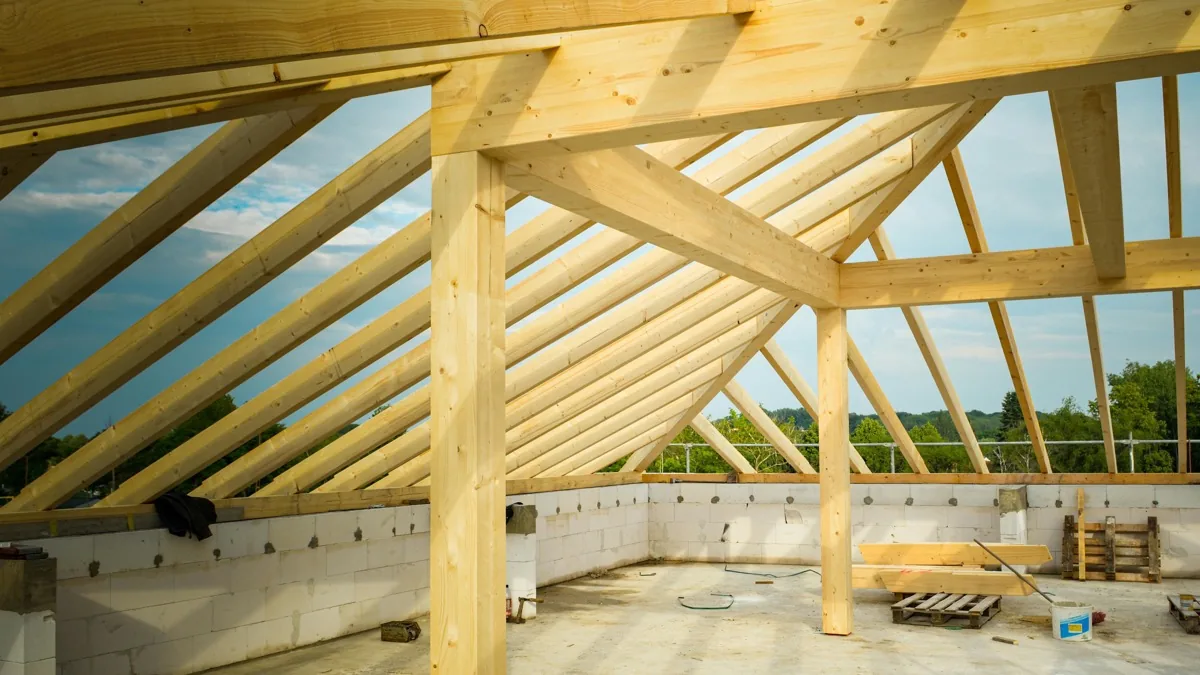
What Makes a Wall Load-Bearing
Load-bearing walls carry weight from the roof, upper floors, and their associated framing down to the foundation. They're an essential link in the building's structural chain.
Exterior Walls
Nearly all exterior walls are load-bearing. They support the roof and any upper floor loads at the building's perimeter. Even walls that appear to have only windows and doors are typically structural.
The foundation walls below align with exterior walls above for this reason. The load path must be continuous from roof to footing.
Interior Load-Bearing Walls
Interior walls may or may not be load-bearing. The determining factor is what's above them.
If floor joists or roof rafters span the full width of the house without intermediate support, interior walls are just partitions. But in most homes, spans are too long for unsupported joists. Interior load-bearing walls provide mid-span support.
These walls typically run down the center or at one-third points of the floor plan, reducing the span each joist must cover.
How Loads Transfer
The load path in a typical house:
Roof loads transfer to rafters or trusses. These bear on exterior walls and, in many designs, a ridge beam or interior bearing wall.
Floor loads transfer to floor joists. Joists bear on exterior walls and often on an interior bearing wall or beam.
Wall loads accumulate at each level, eventually reaching the foundation.
Interrupting this path at any point creates a structural problem. That's why removing load-bearing walls requires installing alternative support like beams and posts.
How to Identify Load-Bearing Walls
Several visual and structural clues help identify which walls carry structural loads.
Joist Direction
Look at the floor joists above (or the ceiling joists below). Walls running perpendicular to the joists are more likely load-bearing. They provide support for those joists.
Walls running parallel to the joists typically don't bear structural load from above, though there are exceptions.
In basements, the joists are often visible. On upper floors, you may need to access the attic or check drawings.
Stacking
Load-bearing walls tend to stack vertically through the house. A bearing wall on the first floor typically has a bearing wall directly above it on the second floor.
If you see a wall that continues through multiple levels in the same position, it's likely structural.
Basement Evidence
Look at what's directly below the wall in question. Load-bearing walls typically sit above:
A beam running across the basement.
A foundation wall or concrete wall.
Posts or columns supporting a flush beam.
If there's nothing substantial below the wall, it may be a non-bearing partition.
Wall Construction
Load-bearing walls are often built differently than partitions:
Larger header beams above doors and windows.
Doubled top plates connecting to framing above.
Closer stud spacing in some cases.
However, many builders use similar construction for all walls, so construction details aren't definitive.
Original House Plans
If available, the original architectural plans clearly indicate bearing walls. These documents show structural intent far more reliably than visual inspection.
Many municipalities keep building plans on file. Check with your local building department.
Common Inspection Findings
Inspectors flag several types of load-bearing wall concerns.
Sagging Above the Wall
If the ceiling or floor above a wall sags toward or away from the wall line, the wall may be shifting, settling, or failing to provide adequate support.
Sagging toward the wall often means the wall has settled, and the framing above is following it down.
Sagging away from the wall can mean the wall has been compromised or removed, and the unsupported span is deflecting.
Severity: Moderate to high. Structural investigation needed.
Cracks at Wall Intersections
Diagonal cracks at corners where walls meet ceilings, or horizontal cracks where walls meet floors, can indicate the wall is moving relative to the structure around it.
These cracks often appear at the top of bearing walls that have settled, or at bearing walls carrying excess load.
Severity: Variable. Minor cracks may be cosmetic. Significant cracks with displacement warrant evaluation.
Modification Without Permit
Reports often note when walls appear to have been removed or modified without evidence of proper permitting or engineering.
Common signs include: missing walls shown on original plans, inadequate headers above openings, sagging near the modification, and no visible posts or beam to replace the removed wall.
Severity: High if structure is compromised. Engineering review recommended.
Inadequate Support Below
A load-bearing wall needs something to bear on. If the wall sits on a floor system without proper posts, beam, or foundation below, the floor will deflect under the accumulated load.
This is common in older homes where basements were modified without understanding structural requirements.
Severity: High. The floor is overloaded. Adding proper support is necessary.
Undersized Headers
When openings are cut in load-bearing walls, the framing above the opening (the header) must be sized to carry the load across the span.
Undersized headers sag over time. Signs include: visible deflection of the header, cracks in finishes above doors or windows, and doors that stick or don't close properly.
Severity: Moderate. Header may need replacement or reinforcement.
Renovation Implications
Many homeowners want to remove walls for open floor plans. Understanding load-bearing wall implications is essential before any wall removal project.
What Removing a Bearing Wall Requires
Removing a load-bearing wall requires replacing its function with an alternative support system, typically:
A beam spanning the opening, sized to carry the accumulated load.
Posts at the beam ends, transferring load to the floor structure below.
Adequate support below those posts, continuing the load path to the foundation.
This isn't optional. The loads don't disappear when you remove the wall. They need somewhere to go.
Engineering Requirements
In most jurisdictions, removing a load-bearing wall requires:
A permit from the building department.
Engineered drawings specifying beam size, post locations, and connection details.
Inspection of the completed work before finishing.
Skipping these steps creates liability. The work won't be documented, insurance may not cover damage, and you'll face problems when selling the home.
Cost Considerations
Opening a load-bearing wall is more expensive than removing a partition wall:
Engineering: $300-800 for structural calculations and drawings.
Materials: Structural lumber or steel beams, posts, hardware.
Labor: Temporary shoring, careful removal, beam installation, finishing.
Typical cost for a single wall opening: $3,000-10,000 depending on span, load, and whether steel or wood is used.
Compare to partition wall removal: often under $1,000.
When the Answer Is No
Some load-bearing wall removals aren't practical:
When the required beam would be too deep to fit in the ceiling space.
When post locations would block traffic flow or occupy impractical positions.
When the cost exceeds the value gained.
When foundation modifications would be required to support new loads.
A qualified engineer can tell you whether your desired modification is feasible.
Related Terms
Partition Wall
A non-load-bearing wall that divides space but carries no structural load. Can be removed without structural modification, though plumbing, electrical, and HVAC in the wall must be addressed.
Header
A horizontal structural member above openings in load-bearing walls. Headers span the opening and transfer loads around it to the studs on either side.
Beam
A horizontal structural member that spans between supports, carrying loads from above. When load-bearing walls are removed, beams typically replace them.
Post
A vertical structural member that transfers loads from a beam to the floor structure below. Positioned at beam ends and sometimes at intermediate points for long spans.
Load Path
The continuous route that structural loads take from their origin (roof, floors) down through the building to the foundation. Every building element along this path must be capable of carrying its share of the load.
When to Get Professional Help
Consult a structural engineer when:
Your inspection report flags concerns about load-bearing walls.
You're planning any renovation that might affect walls.
You see sagging, cracking, or deflection near wall locations.
Previous owners may have modified walls without proper engineering.
You're purchasing a home with open floor plan modifications and want verification they were done correctly.
Engineering assessment for load-bearing wall evaluation typically costs $300-600. Compared to the cost of structural repair, it's a sound investment.